
AI Overview
Ceiling repair costs $350–$600 for a standard room; full replacement costs $800–$2,500. But repair on a ceiling with underlying strapping failure or water-damaged substrate lasts 6–18 months before re-failing, meaning three repair cycles can exceed replacement cost while leaving the structural problem unsolved.
Key highlights
- ›Repair is cost-effective only when the cause is isolated and the substrate is sound
- ›Full replacement costs 2–4x repair upfront, but lasts 20+ years vs 6–18 months for repair on a failing substrate
- ›Insurance claims are more straightforward with a full replacement scope than multiple repair cycles
- ›Asbestos-containing ceilings require licensed removal, there is no 'repair' option
- ›In Perth's climate, most adhesive-fixed plasterboard from the 1980s–90s is in its failure window
- ›Get the diagnosis right first, the wrong choice is expensive either way
The ceiling repair-vs-replace decision is one of the most common questions Perth homeowners get wrong, in both directions. Some replace ceilings that would have held for another decade with a $400 patch. Others patch ceilings that fail again within a year, and end up spending more in total than a replacement would have cost.
Getting this decision right requires a correct diagnosis of why the ceiling is failing, not just what it looks like from below. A visual inspection of the surface tells you the symptom. Understanding the strapping condition, the adhesive bond, the moisture history, and the ceiling's age tells you the cause.
Here is a structured comparison of both options, with realistic Perth prices, and the specific conditions under which each is appropriate.
When ceiling repair is the correct call
Repair is the right answer when four conditions are met simultaneously: the damage is isolated (under 1 square metre), the surrounding plasterboard is structurally sound, the strapping is in good condition, and there's no water damage to the substrate. When all four are true, a correctly executed repair will hold.
Outside these conditions, repair is a deferral, not a solution. It buys time, sometimes useful time, if you're managing a property and want to defer capital expenditure, but it does not address the underlying structural cause.
When ceiling replacement is the correct call
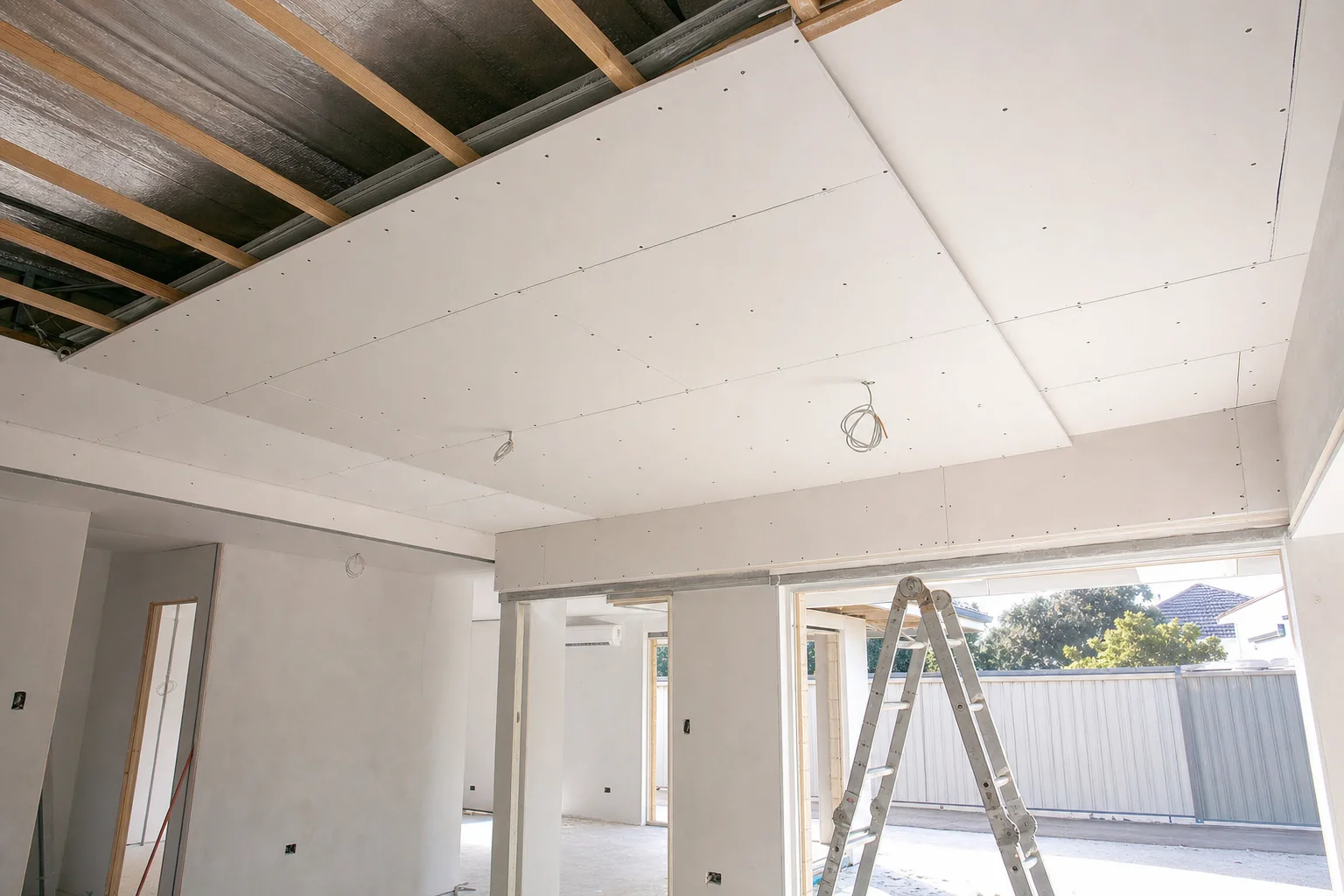
Replacement is indicated when any of the following are present: multiple sagging bays, recurring cracks (same location, second or third occurrence), water-damaged substrate with delaminated paper face, systemic strapping failure, asbestos-containing material, or a ceiling that is 30+ years old with no previous replacement.
- Sheets pulled, strapping exposed and inspected
- Failed or marginal strapping replaced with new galvanised furring channel
- New 10mm Gyprock CD at code-specified screw spacing
- Set to AS/NZS 2589 Level 4 (living areas), joint-free surface
- 20+ year service life when done correctly
- Paint-ready handover
- Surface damage filled and painted over
- Strapping condition unknown, not inspected
- Adjacent failing areas not addressed
- Surface patch over compromised substrate
- 6–18 month lifespan on failing substrate
- Same call in 12 months
Full cost comparison, repair vs replace over 5 years
| Scenario | Upfront cost | Year 2 | Year 4 | 5-year total |
|---|---|---|---|---|
| Correct repair (isolated, sound substrate) | $400–$700 | $0 | $0 | $400–$700 |
| Repair on failing substrate (re-fails annually) | $400–$700 | $400–$700 | $400–$700 | $2,000–$3,500 |
| Full replacement | $800–$1,800 | $0 | $0 | $800–$1,800 |
| Full replacement (with strapping) | $1,200–$2,500 | $0 | $0 | $1,200–$2,500 |
On a failing substrate, three repair cycles costs more than replacement and you still have an unresolved ceiling. The economic case for repair disappears when the substrate is compromised.
The cheapest outcome is the one that addresses the actual problem once. An on-site inspection before committing to either approach costs you 30 minutes and gives you the information to make the right call. We provide written fixed-price quotes for either scope.
The insurance angle, replacement vs repair in claims
When a ceiling is damaged by an insured event (storm, burst pipe), the insurance claim scope is typically 'restoration to previous condition.' Insurers generally accept replacement of damaged sections as appropriate scope when the damage is structural.
A scope that specifies repair-only on a water-damaged ceiling where the substrate is compromised is likely to be under-scoped. The insurer may accept it initially, but if the ceiling re-fails within the claim period (typically 12 months), you're into a dispute about what was properly repaired.
A properly scoped full replacement claim, supported by written documentation of the damage extent and substrate condition, gives you a clean outcome and a ceiling that won't fail again within the claim period.
Three real Perth scenarios and the right call for each
Scenario 1: 2015 Joondalup home, one sagging bay after a roof leak
The roof was fixed before calling us. One bay of the living area ceiling is sagging, the sheet has absorbed water, the paper face is bubbled. Adjacent sheets appear sound. Strapping checked: sound and correctly spaced. Verdict: replace the one sheet and affected cornice section. Repair is not appropriate because the sheet integrity is compromised, but the surrounding structure is fine, no need for a full room replacement.
Scenario 2: 1988 Stirling home, recurring cracks in main bedroom
Patched twice in the last three years. The cracks return within six months each time. Strapping check reveals adhesive-fixed plasterboard, the adhesive bond has failed across two bays, and two others are marginal. Verdict: full bedroom ceiling replacement, including strapping inspection and replacement of failed furring channel. Patching a third time is not a viable answer.
Scenario 3: 1972 Morley home, textured acoustic ceiling throughout
No visible damage yet, but the owner is renovating and wants to modernise. Asbestos assessment confirms the textured spray contains chrysotile asbestos. Verdict: licensed Class B removal followed by full plasterboard replacement across all rooms. There is no repair option for asbestos-containing material, it must be removed under licensed procedures.
How to make the call, a practical decision framework

Check the build year
Pre-1985 homes: asbestos assessment before any decision. Anything before 1995: strapping inspection required before committing to repair.

Look at the scope of damage
One bay, isolated, no water damage, sound strapping: repair candidate. Multiple bays, recurring, water-affected, failed strapping: replacement territory.

Count the previous repairs
First occurrence on sound substrate: repair is appropriate. Second occurrence in same location: the cause is ongoing. Third: replace.

Get a written scope before committing
Don't accept a verbal quote for either option. A written fixed-price scope protects you from scope creep and gives you something to compare between contractors.
Check the build year
Pre-1985 homes: asbestos assessment before any decision. Anything before 1995: strapping inspection required before committing to repair.
Look at the scope of damage
One bay, isolated, no water damage, sound strapping: repair candidate. Multiple bays, recurring, water-affected, failed strapping: replacement territory.
Count the previous repairs
First occurrence on sound substrate: repair is appropriate. Second occurrence in same location: the cause is ongoing. Third: replace.
Get a written scope before committing
Don't accept a verbal quote for either option. A written fixed-price scope protects you from scope creep and gives you something to compare between contractors.