
AI Overview
Ceiling repair is appropriate only when damage is isolated, the substrate is structurally sound, and the strapping is intact. When sagging spans multiple bays, strapping has failed, or water has compromised the sheet, repair delays the inevitable, and often costs more in the long run than a single full replacement.
Key highlights
- ›Sagging across multiple ceiling bays means strapping has failed, not just one sheet
- ›A patch on failed adhesive will re-fail within 6–18 months
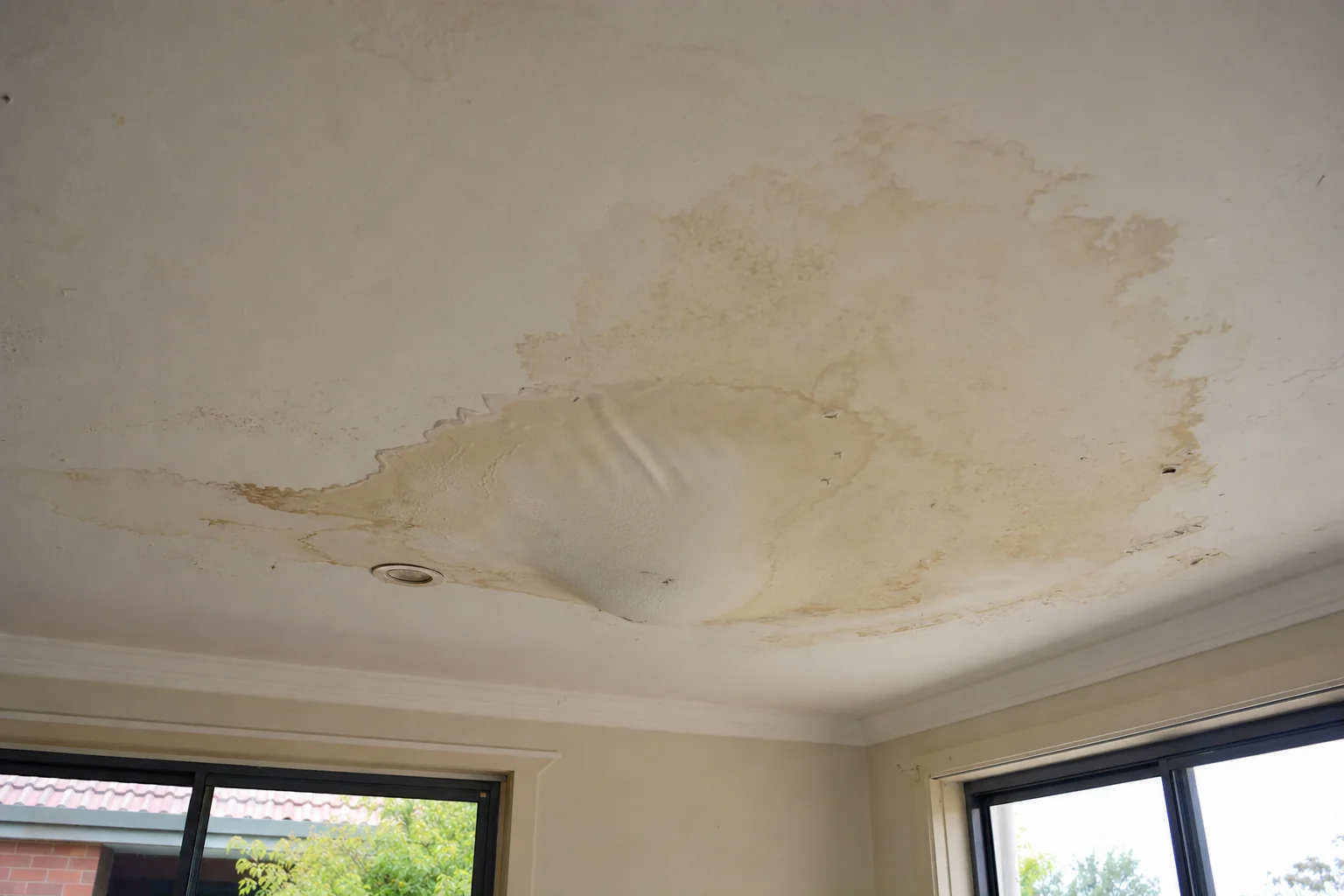
- ›Water-stained ceilings where the paper face has bubbled cannot be structurally repaired
- ›Ceilings that have been patched more than once are telling you something
- ›Pre-1985 ceilings with textured finishes need asbestos assessment before any repair work
- ›Replacement costs more upfront but is typically cheaper than three repair cycles
Most homeowners who call us have already tried the repair approach. A plasterer fills the crack, paint goes back on, and for a few months everything looks fine. Then the crack reappears, usually in the same place, sometimes worse.
That's not a failure of the patch itself. It's a failure of the diagnosis. Patching treats the surface; it doesn't address what's happening in the structure behind the sheet. When the underlying cause is strapping failure, adhesive breakdown, or water damage to the substrate, a patch is a temporary cover, not a fix.
These are the seven specific signs that tell you repair won't solve the problem.
Sign 1: The ceiling is sagging across multiple bays
A ceiling is divided into bays by the strapping (furring channel or timber battens) that runs between the rafters. Each sheet of plasterboard spans one bay. When a single bay sags, the problem might be isolated, a failed strap, a loose screw, a small water leak.
When multiple adjacent bays are sagging, the problem is systemic. The strapping system has failed across a run, or the adhesive that was used to fix the sheets has let go along a wider area. Patching the visible sag in one bay doesn't address the adjacent bays that are in the same condition, it just changes which one falls next.
If you can see three or more sagging bays in a row, the strapping run between them has failed. Replacing individual patches in that run is a temporary measure. Full replacement, sheets out, strapping inspected and replaced, new plasterboard installed, is the only thing that addresses the full failure.
Sign 2: The same crack keeps coming back
A crack that reappears after repair is telling you it's a movement crack, not a static damage crack. Static cracks (from a single impact or a one-time event) stay fixed once repaired. Movement cracks (from ongoing structural movement, seasonal expansion/contraction, or strapping failure) reopen because the cause is ongoing.
The classic presentation: a hairline crack along a joint line, repaired twice, comes back wider each time. This is the adhesive or screw fixing cycling through seasonal temperature changes. The joint line is the weakest point, and as the sheet continues to move, the joint continues to crack.
“If the same crack has been patched more than once, the ceiling is moving. Patching a moving surface is not a repair strategy.”
Sign 3: The paper face has bubbled or delaminated
Plasterboard is a gypsum core sandwiched between two paper faces. When water soaks into the sheet, the paper face absorbs it and separates from the gypsum core. You see this as bubbling, rippling, or sagging of the surface, the paper has lost its bond.
Once the paper face has delaminated, the structural integrity of the sheet is compromised. Setting compound applied over delaminated paper has nothing to bond to, it will crack and fall off. The sheet needs to come out.
Sign 4: You've already had it patched twice
One patch is a reasonable response to an isolated problem. Two patches in the same area means the problem is recurring. Three patches means the ceiling is telling you something you're not listening to.
There's a point, usually around the second recurrence, where the accumulated cost of patch repairs exceeds or approaches the cost of a full replacement. At that point, the economic argument for patching disappears. You're paying repeatedly for a diminishing return.
| Approach | Year 1 | Year 2 | Year 3 | 5-year total |
|---|---|---|---|---|
| Patch repair (per occurrence) | $350–$600 | $350–$600 | $350–$600 | $1,750–$3,000+ |
| Full ceiling replacement | $1,200–$2,500 | $0 | $0 | $1,200–$2,500 |
These are indicative ranges for a standard bedroom. The full replacement is a 20-year solution. Patch repairs are not.
Sign 5: The strapping is the actual failure point
Strapping is the grid of metal furring channel (or timber battens in older homes) that spans between rafters and holds the plasterboard sheets. When strapping fails, from corrosion, incorrect installation, or age, the sheets lose their structural support. The ceiling sags regardless of how good the sheets are.
You can't patch your way around failed strapping. The sheets need to come down, the strapping needs to be inspected and replaced where required, and new sheets go back up. There's no shortcut.
Look for even, regular sagging between joints, this is the bay between two straps deflecting. Irregular sagging (one patch lower than adjacent sheets) suggests a single strap failure. Regular sagging across the room suggests systemic strapping issues.
Sign 6: The ceiling may contain asbestos
Pre-1985 homes in Perth may have asbestos-containing ceiling materials, textured spray finishes and fibre-cement sheets are the most common forms. If your home falls in this age range and the ceiling hasn't been replaced, it needs asbestos assessment before any repair work begins.
Sanding, drilling, or cutting asbestos-containing material releases fibres. An unlicensed contractor doing a 'repair' on an asbestos ceiling without assessment and proper containment is not just a bad repair, it's a potential health and legal liability.
If your Perth home was built before 1985 and the ceiling has never been replaced, assume asbestos may be present until an assessment proves otherwise. The assessment is not expensive. The consequence of getting it wrong is.
Sign 7: The entire house ceiling is the same age
Plasterboard ceiling systems have a finite service life. In Perth's climate, hot summers, seasonal humidity variation, the typical failure window for adhesive-fixed plasterboard is 25–40 years. For nail-fixed systems, similar. For lath-and-plaster in older homes, even earlier.
When one ceiling room starts failing, the adjacent rooms are usually the same age and in a similar condition. Replacing one room and leaving the others is common, but understand that you're likely to be back for the next room in 2–3 years. Some homeowners prefer to do the full house in one go and be done with it.
The actual cost comparison: repair vs replace
When we tell a homeowner that repair isn't worth it, we're not upselling. We're applying 20 years of observing what happens to patched ceilings. The ones that get patched once, where the problem was genuinely isolated, hold. The ones that get patched repeatedly over a failing substrate don't.
If you're unsure which category your ceiling falls into, we'll come out and give you an honest on-site assessment. If repair is the right answer for your ceiling, we'll tell you, along with who to call for it.